We’ll Miss Succat Hallel

  • July 12, 2010 6:30 pm

During  our month in Jerusalem, we’ve spent almost seventy hours at Succat Hallel. We’ve done a lot of other things too, but this is what we came for. It’s been an extraordinary blessing, and we’ve also gotten a lot of exercise since it’s a half hour walk to get there.

Quite by accident, we have been here at the time of the Elav Young Adult and Youth Conference. Elav was an enormous faith undertaking for those involved in the ministry here, and for us, it was a privilege to be a little part of it by praying and fasting. About 800 young adults and youth–Jewish, Arab, and international–came together in TelAviv for Elav, and we believe it will have great long-term effects.

We’ll miss Succat Hallel, partly because such great things are happening. We’ve heard for years about the “back to Jerusalem” belief in the rapidl- growning church of China. Next month, a group of Christian leaders will come from China for three months of study at Succat Hallel. Some of these people lead networks of up to a million Christians.

We’ve learned a lot, but there’s so much more to learn. Right now, Rick and Patty Ridings, the couple that founded Succat Hallel, are meeting with leaders in Turkey. There are big changes taking place in Turkey right now, and we would love to know what is happening within the churches there. There’s a budding revival among Arab youth in Nazareth, which we would like to know more about. We have learned a bit about Messianic Jewish congregations and have learned a lot from their teachings, but we didn’t get to visit any of them.

People keep coming from all over the world to worship and pray. Tonight we heard the story of a Texan, who was drunk or stoned every day for twenty-eight years, and then Jesus stepped into his life. He’s been to many nations and has won thousands of people to faith in Jesus. Now his ministry is in the ancient city of Jericho where he ministers to Arab Muslims, and he has started a house of prayer there.

One of the most interesting and inspiring things we have learned is that houses of prayer, many of them 24/7 are springing up all overthe globe. A new one is starting in Beirut, Lebanon. There’s one in Alexandria, Egypt. They’re starting in Turkey and all over the Middle East. This is a huge phenomenon that we knew nothing about until we visited International House of Prayer in February.

Tonight we also heard the story of two people from Bethlehem who have converted from Islam to Christianity. Both of them have been driven from their homes and families and their lives have been threatened. We prayed for their protection, their future, and their families.

So, Jerusalem is still fascinating. We’re so thankful for the wonderful experiences we’ve had, especially the phenomenal worshp at Succat Hallel. We’ll look forward to our next trip here, but our big house at home will look pretty good after this one-room apartment. And we can’t wait to wrap our arms around Sophie and Sam.

Playing My Flute in Jerusalem

Briefing at the Ministry of Foreign Affairs

  • July 12, 2010 1:05 am

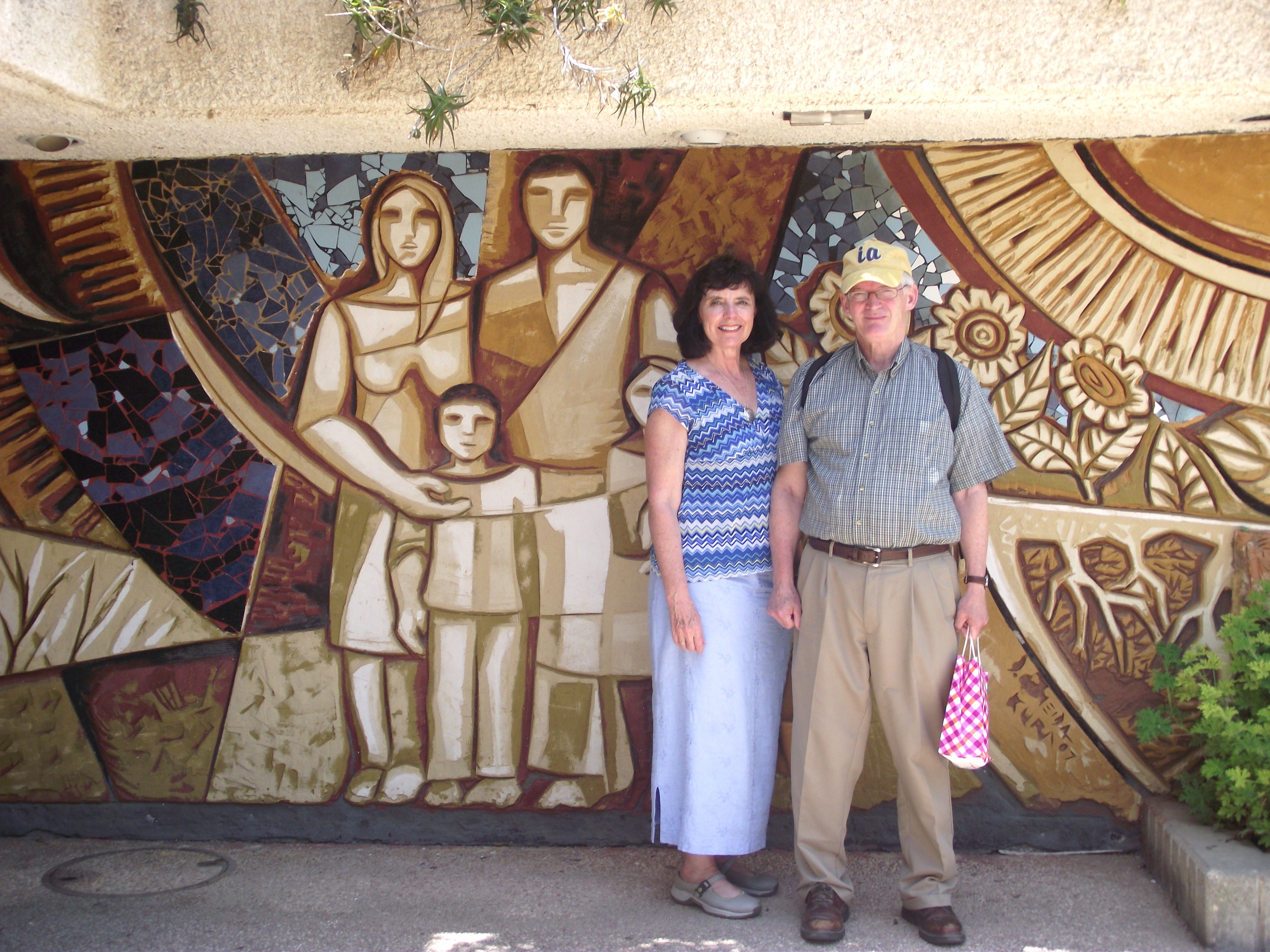
Art Outside the Ministry of Foreign Affairs

We would never have expected a private briefing with a Deputy Spokesman at the Ministry of Foreign Affairs, but Allan Ross, Director of the Jewish federation of the Quad Cities  arranged it. So, this morning we met for over an hour with a forthright young  man at the Ministry, who was not just a propagandist and seemed genuinely interested in our experiences in Israel, in the West Bank, and in the Quad Cities.

We had a frank and friendly exchange of views and learned some things we didn’t expect. The meeting was very useful to us in our efforts to fit the pieces together, and I’m sure Art will be including some of the items we discussed in his upcoming presentations at home. He’s doing a four-part series on the Arab-Israeli Conflict in August.

Old City Shopping

  • July 10, 2010 7:32 pm

Which man do you think got the better of the bargain?

Yesterday we went to the Old City to shop for gifts. This can be an overwhelming experience, so we determined our strategy in advance. We would look on our way through, make our decisions, and buy on our way back. Cagey bargainers that we are, we came out of the first store we entered with two items. The shopkeeper was kind enough to try to persuade us not to tell anyone what a bargain we got because he was so desperate, and we are “not easy.” He would be embarrassed for people to know how little profit he made. Right!

All in all, it was a good day. We wandered around and spent as much money as we were willing to. I have a weakness for instruments, so I bought another wooden flute and a bedouin stringed instrument that you play with a bow. The shopkeeper guaranteed me that it was real bedouin and not made in China.

We made our way without getting lost to the Western Wall. Then we carried on our traditional of eating at a restaurant in the Jewish quarter which has excellent food and a good view of the Western Wall and temple mount.  We made one more stop at the spice market and then walked in the hot afternoon sun to our bus 18 stop. By the time we made it back home, we were definitely ready for a nap.

Art at the Western Wall

Qalandiya Refugee Camp

  • July 10, 2010 6:49 pm

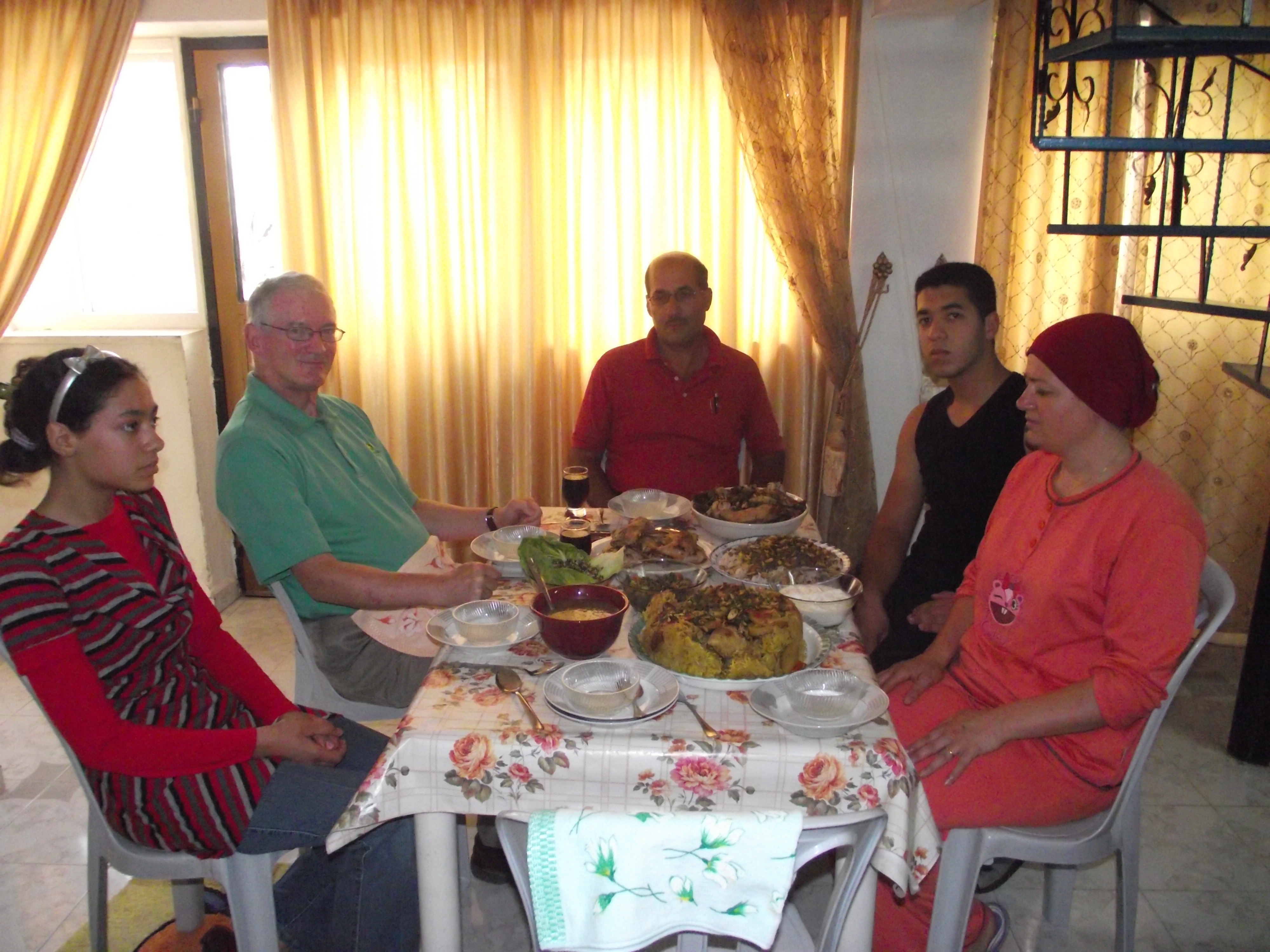
Art with Hasan and family at their home in Qalandiya Refugee Camp

We certainly didn’t expect to go to a Palestinian refugee camp, but our two visits to the Qalandiya camp have been an extremely good experience. Art has taught for years on the issue of Palestinian refugees without ever knowing one of these refugees personally. We already had a lot of information, but filtering our knowledge through the lens of Hasan’s experiences has deepened our understanding. And since Hasan invited us into his home as friends, we have enjoyed the pleasure of Arab hospitality, which is both generous and gracious. What a delicious meal–even makloubeh!

One of our privileges was to pray for Hasan’s eighteen-year-old daughter, who was born prematurely and has never been able to walk. Her dream is to be an English teacher. We found that this Muslim family received our Christian prayers very openly, and we are continuing to pray for Isra along with our church at home and our friends in Sierra Leone.

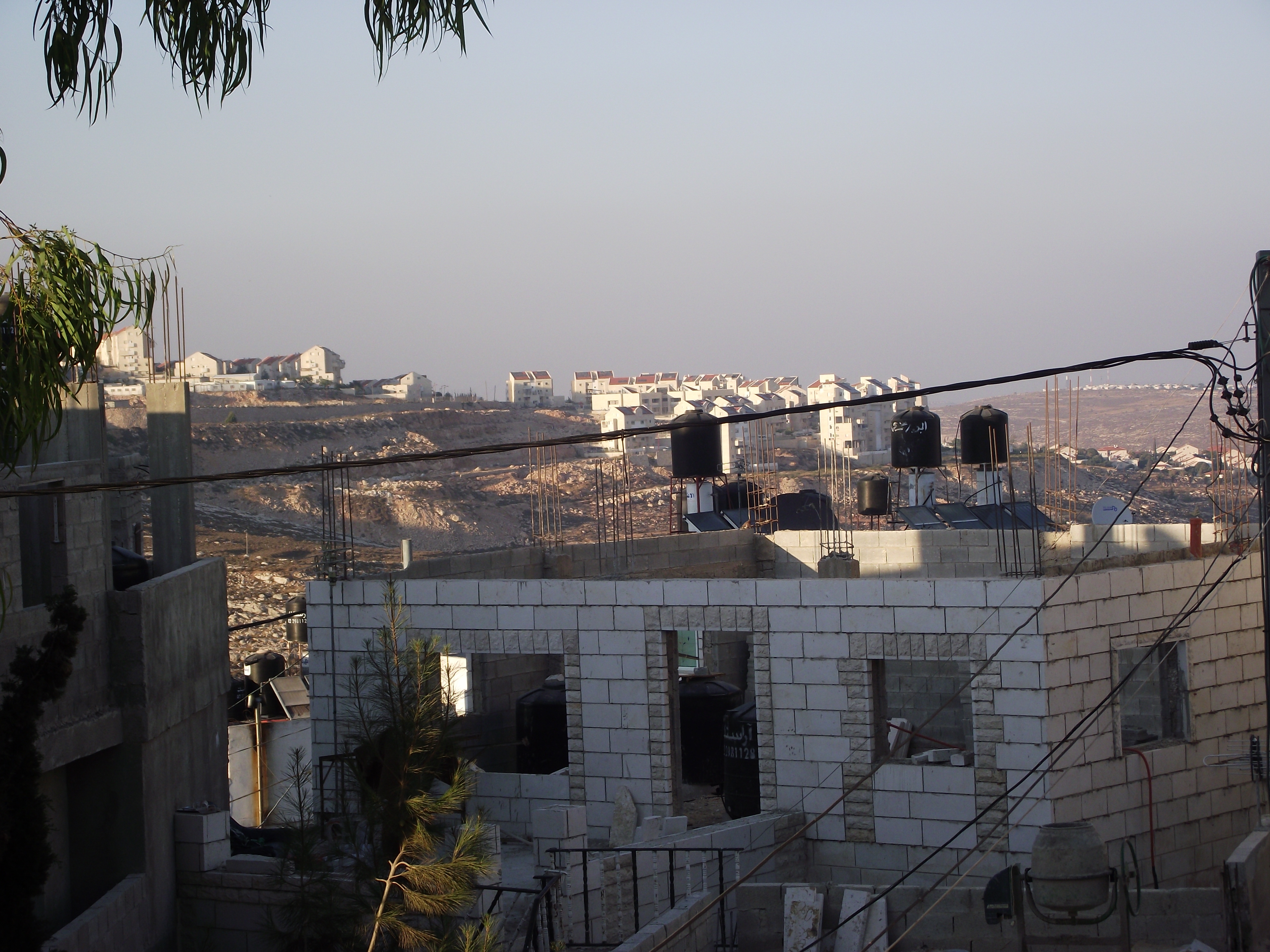
Israeli settlement in the distance as seen from Hasan's rooftop

Hasan drives his taxi thirteen hours per day and usually six days per week in order to take care of his family. They have built a very nice home which they were happy to show to us. From the rooftop, where they raise rabbits and do laundry, you can see the nearest Israeli settlement on a nearby hilltop. This is a constant reminder of their grievance over lost property and lost freedom. More practically, it is a reminder of one of the most critical unresolved issues–water. Right now Israel controls the water that flows to Palestinian homes and is sometimes shut off.

Our time with this family was so pleasant because their family relationships are so loving. Even though Hasan and Sousan (same name as mine, but in Arabic) first met on their wedding day, it is obvious that they have a strong marriage and that they treasure each other and their children.

I don’t know when the day will come that they will be able to travel to Jerusalem again, but until then, we will continue going through the Qalandiya checkpoint to visit them. I hope they will always welcome us as warmly as they did this week.

Haifa

  • July 10, 2010 4:07 pm

Haifa Beach

Although we have concentrated on Jerusalem during our stay here, we took a day trip to one of our favorite cities, Haifa. Not only is Haifa situated in a beautiful location on the blue Mediteranean seacoast, but part of the city sits on the Carmel Mountains, the place where Elijah won his dramatic contest with the prophets of Baal. And it is home to three generations of the family of our first and foremost Jewish friend, Ida Kramer, who is the current President of the Jewish Federation of the Quad Cities.

This was also our first trip on the expanded Israeli rail system, which we enjoyed greatly. Haim, Jeanette, and Leroz met us at the station, and we walked along the beach.

Then we had another special treat, a trip to Zikron Ya’acov, one of the original settlements of the first aliyah. We visited an extremely interesting museum, the Aronson home and museum. The Aronson family ran a spy ring called Nili, that helped the British defeat the Ottomans during WWI.

Art at the Aronson musem--photo of the Aronson family

I’m emphasizing “interesting” for the sake of our adult children, who still talk about the day in 1983 when their daddy took them to a record five museums in Haifa, when all they really wanted to do was go to the beach.

Gilad’s Concert

  • July 9, 2010 9:51 pm

Israeli Philharmonic Orchestra Concert for Gilad Shalit

We knew that Ronit planned to take us to a concert of the Israeli Philharmonic Orchestra conducted by Zubin Meta, but we didn’t realize how special an experience this would be. The concert, which was attended by 9,000 people, was an outdoor concert in support of Gilad Shalit, the Israeli soldier who was captured by Hamas four years ago.The purpose of the concert was to ask for international support to pressure Hamas to treat Gilad Shalit according to international standards.

The music was phenomenal. Gilad’s father spoke briefly. The logistics involved and the level of organization was amazing. The queue of 120 large buses was a sight to behold. 

Don't we look comfortable!

Gilad Shlit’s situation is a big controversy right now. Negotiations are underway for a prisoner exchange that could gain his release. But Hamas is demanding the release of 1000 prisoners, many of whom are known terrorists. The public sympathy for the Shalit family is enormous, but how many more soldiers will Hamas hold hostage if their demands are met?

Thanks, Ronit, for a beautiful day.

Or Haner

  • July 9, 2010 9:27 pm


New art panel at Kibbutz Or Haner

In Or Haner there are broad, flat plains like in central Illinois where I grew up, and the corn is so tall and lush that it looks like Iowa. And John Deere tractors work there way back and forth across the fields and haul harvests of produce and feed for livestock. It looks like home, but it’s Sha’ar HaNegev, the gateway of the Negev dessert to the south. It’s hard to believe that a little over fifty years ago, this place was desolate.

Wednesday we made our third visit to Or Haner, since we had been there in 2005 and 2006, and things are much quieter now than they were then when qassam rockets were being launched regularly from nearby Gaza. It was good to see the progress that has been made there in a short time. The kibbutz is even more lovely as a result of the work of Argentinian artists who painted several panels like the one in the photo.

Ronit, our Or Haner friend, who has visited the Quad Cities twice, picked us up in Jerusalem, and we enjoyed catching up on her news on the drive to Sha’ar HaNegev. It was lunchtime when we arrived, so we had a great lunch in the kibbutz dining room. Or Haner is one of the few kibbutzim that still has a communal dining facility, and they provide catering for other nearby kibbutzim. There are several in the area. It’s interesting to see the transitions in the kibbutzim movement since the early pioneering days with they were so vital to the establishment of the Jewish state. Or Haner has a new neighborhood where private houses are being built for families who will receive services from the kibbutz, but are not members. Especially for young families with children, kibbutz life looks like a great option. It’s clear that a modern kibbutz survives on business acumen, not just hard work and courage.

While we were there, we talked with our friend Dr. Ruthie Eitan, who is a professor at Sapir College. Ruthie was the one who had the vision for a partnership between Sapir College and St. Ambrose University, which was developed since our last visit. We also met, for the first time, Dr. Uri Rosset, who will be coming to the Quad Cities in September. Uri is an expert on Islamic extremist groups.

Worship in the Old City

  • July 8, 2010 8:10 pm

Greek Catholic Church

On Sunday we went with Rita and Natalie to the Melkite Greek Catholic Church in the Old City. It’s just inside Jaffa Gate on Greek Catholic Patriarchate Street. Nothing could be more different from our church, Faith Walk World Outreach Center in Silvis, Illinois. The Greek Catholics use the Orthodox liturgy, but are part of the Roman Catholic Church. The walls and ceiling are covered with icons, and the priests carry out important parts of the service behind the iconostasis, but we in the congregation can peer in through the open door.

The priest who conducted the service is an Egyptian with a great sense of humor. We didn’t understand what he was saying, since the service was conducted in Arabic, but Art figured that he was joking about the beam of sunlight that shone brightly through a window in the domed ceiling directly on him. The people were warm, and little children played during the mass. Unlike the Greek Orthodox and Roman Catholic churches, Protestants are welcome to receive the eucharist, which we appreciated.

After that, Rita and Natalie took us on a walk through the Old City to what is arguably the most special church on earth, the Church of the Holy Sepluchre. This old crusader structure is the traditional site where Jesus was crucified, buried, and raised from the dead. It’s cavernous with many corridors, stairs and altars, but without any large cathedral style room. According to tradition, Adam’s tomb is directly beneath Calvary, so Jesus’ blood trickled from the cross down to the place where Adam’s remains lay. Even when the church is crowded with tourists, it has a very special feel.

Then we had the great pleasure of a wonderful afternoon in the home of our new Palestinian Christian friends. Our meal included stuffed leg of lamb and other Arab specialties–so delicious. The hospitality was delightfully gracious, and the conversation was interesting. Praise the Lord for another wonderful day!

Divided Land

  • July 8, 2010 6:03 pm

The security fence winds over the hill toward the Dead Sea.

Jerusalem has a unique architectural unity, much more so than other beautiful, ancient places that are now modern cities. There’s nothing monotonous about the building styles. The wonderful coherence comes from the golden, cream-colored Jerusalem stones that are the structure and facade of everything from the old city wall, built in the 1500′s by Sultan Sulieman the Magnificient, to the newest office building or hotel.

But the unity ends with the stones, and the divisions are everywhere. From our regular vantage point at Succat Hallel, the security fence, erected by Israel to stop the terrorist violence that occured during the Second Intifada, winds like a silver ribbon from Jerusalem over the hills in the direction of the Dead Sea. It has accomplished it’s objective. We, like the people who live here all the time, ride buses and eat in restaurants without constant anxiety about terrorists. This wasn’t the case the last time we stayed in Jerusalem or when we visited Gaza and could hear the rocket warnings.

The security fence looks different up close and from the Palestinian perspective. We saw the wall near the Qalandiya Checkpoint, where Hasan, our taxi driver friend, pointed out “the longest letter in the world.” It’s written in large letters on the wall. As you drive along, you get the gist of it without really being able to read it. The substance is that the Israeli occupation of the Palestinian territories is like the apartheid system that has finally fallen in South Africa. People from all over the world have come to paint pictures and write messages in support of the Palestinian cause and to plead for justice.

But the ongoing Israei-Palestinian conflict is just one of the divisions. The rift between secular and religious Israelis is deep. Many secular Israelis regard ultra-orthodox Jews, a rapidly growing sector that holds great political and receives massive subsidies while denying the legitimacy of the State of Israel, with as much contempt as they regard the Palestinian Arabs. We talked with a Palestinian man who said that he hates the Druze, an Arab subgroup that supports the Israeli government. The Bedouins, also Arabs, played an important role in the military victories that made the Jewish State possible, but they are discriminated against.

Palestinian Christians, an increasingly smaller group since there has been a huge outmigration of Christians, have a difficult time in the midst of a Muslim majority. And Messianic Jews, a group which is growing more rapidly than any time since the first century, are not considered to be Jews by religious Jews and are rejected and sometimes persecuted. No wonder this is such an interesting place!

Into the Palestinian West Bank

  • July 3, 2010 10:09 pm
Ramallah, with a population of 60,000, is the cultural and political center for Palestinians in the West Bank. About eight miles from Jerusalem, it is the seat of the Palestinian Authority, which was founded by Yassir Arafat and is currently led by Mahmoud Abbas. Ramallah once had a large Christian population, and still has a much larger proportion of Christians than Bethlehem or Nazareth, which are overwhelmingly Muslim. The city was occupied by Israeli forces during the Second Intifada in 2000, but Israelis have withdrawn from Ramallah, and it is a prospering and safe West Bank city.
A few days ago, we visited Ramallah for the first time. As recently as five years ago, this would have been unthinkable to us, partly because we believed it was dangerous and partly because Ramallah was so closely associated with the political leadership of Yassir Arafat. On our most recent visit to Israeli in 2006, when we were lost trying to find our way to the Christian village of Taybeh in a car with an Israeli license plate, we accidentally came to the outskirts of Ramallah. When we realized it, we high-tailed it out of there as inconspicuously as possible.
We didn’t plan to go to Ramallah, but our taxi driver, who we liked and trusted, on our visit to Taybeh offered to show us the Qalandiya Refugee Camp, where he was born and is now raising his family of five children. So, the next week we went.

It was a pleasant and eye-opening trip. We felt safe and were surprised at how prosperous and clean the city is. We even saw Yassir Arafat’s tomb. The trip confirmed our belief, which Art held from the many magazines and journals he reads, that the situation in the West Bank is improving. It is difficult for people who live there to admit this, but for the time being, it seems almost undeniable. This view was confirmed this week in an article by Thomas Friedman, a journalist we respect, in the International Herald Tribune. The problems are still enormous, but we praise God for any signs of progress.


Your email: